What AI anxiety taught me about parenting. And vice versa.
It’s Monday, and I know some of you are staring at a blinking cursor in a ChatGPT window, unsure what to even type. The screen feels too quiet, too expectant, like it’s waiting for brilliance you’re not sure you have (spoiler: you do).
Last week, someone at a happy hour was raving about their latest AI win:
“It drafted the whole memo!” “Five brand frameworks in five minutes!” “I used it to write a lullaby!”
You nodded, smiled, sipped the lukewarm white wine they serve at work functions, and maybe felt a quiet panic rise. Am I falling behind? Am I the only one not thrilled about this? Is this really a thing I need to master now?
If that’s you, I want to say: I get it. I really do.
I’m someone who genuinely loves using LLMs. I’ve found creativity, clarity, and momentum in them. But even as a believer, I still see something deeper at play: a shared anxiety that goes far beyond tech literacy. A deeper fear of getting it wrong.
But truly. It is a fear I know intimately because I feel it every Sunday morning, staring at my 15-month-old baby.
An Overused LinkedIn Metaphor Comparing AI to Parenting
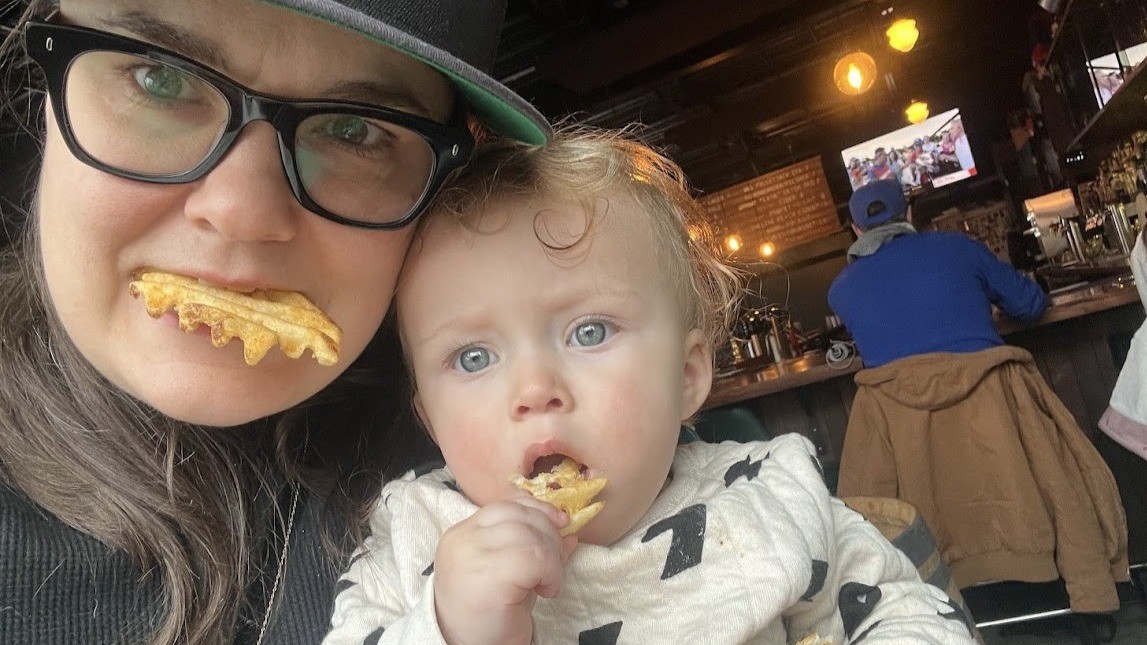
Sunday is my one full day alone with my daughter, Frankie. Just the two of us. No work, no backup, no expert in the wings.
I hear her through the monitor. Soft rustles, a little babble (no surprise, she’s a talker!) and I head in to start the day.
She’s still in her sleep sack, wild-haired and slow to wake, so I get a moment to just enjoy her existence. I lift her up and her arms wrap tightly around my neck, a grip I feel all the way in my gut. She smells like sleep and milk and magic.
But as soon as I put her down, the questions start flooding in. What should we do today? Is it too hot for the park? Where’s the diaper bag? Is she behind on something? Should she be walking already?
And just like that, I’m spiraling. No dashboard. No quarterly review. No roadmap. Just a tiny human looking up at me with total trust.
That fear that I’m not doing enough, or not doing it right, is the exact same energy I hear in so many conversations about AI.
AI Anxiety Echo (Chamber)
It’s not always about the tech. It’s about agency.
Are we the kind of person who gets it? Are we advancing fast enough? Are we being responsible? Should we wait for the rules or is it already too late?
And when those questions get too loud, we freeze or we posture. We don’t engage. We perform. We panic. We opt out entirely.
Which is why Aimee Pedretti, GPHR, SHRM-SCP 's talk this week at another phenomenal AI Portland event landed so deeply for me. Aimee is a futurist, and she invited us to try something radically different. Not to fearfully predict what’s coming, but to playfully participate in building what could be.
Imperfect Practice Makes Possible
Aimee reminded us that imagining better futures is something we have to practice, because our brains are wired to default to the worst-case scenario. The Terminator narrative comes naturally. But the tender, nuanced, hopeful future? That takes effort. It takes discipline. And it takes community.
She introduced the concept of "signals of change". Breadcrumbs pointing toward brighter possibilities. Remote work before it was mainstream. The rise of open-source tools. A generation of kids learning to code with LLMs the way we learned PowerPoint.
Signals aren’t guarantees. They’re invitations. To notice. To experiment. To show up before we feel fully ready.
CHOOSING OPTIMISM, INTENTIONALLY
Aimee asked, who benefits from your hopelessness? Because whether it’s parenting, AI, climate change, or democracy, the message is the same. If we assume we can’t shape the future, that we’re not equipped to try, that we need permission or perfection before we begin we surrender the opportunity to build the 2035 we actually want.
I don’t want to live in that surrender.
I want to show up. For Frankie. For my community. For work that still feels messy and human and full of stakes. Even when I’m uncertain. Especially then.
And I want to shift my own internal script from Am I doing this right? to Am I showing up with care? With curiosity? With a willingness to fail, learn, and try again?
Because that’s what Frankie teaches me. She doesn’t need perfection. She needs presence. She needs joy. Rhythm. Play. And someone to do those things with.
The Future We’re Practicing
AI, like parenting, isn’t a space for rigid control. It’s a space for thoughtful experimentation. Yes, we need guardrails. Yes, we need governance and transparency.
But we also need play. We need space to get it wrong on the way to something deeply right.
During the talk, Aimee led us through a guided visualization:
It is the year 2035 and you are just waking up. It’s one of your five days off. You work two days a week now not because you're underemployed, but because agentic systems and ambient automation handle the bulk of mundane coordination, data sorting, and task triage that used to fill your calendar. Your job is to be creative and strategic. You no longer measure your worth by how many tabs you kept open or how many meetings you survived.
Outside your window, neighbors are setting up for the weekly street market. You’ll head down soon to help, because your work includes space to belong, to connect, to maintain and grow your local ecosystem.
You’re not hustling for productivity points. You’re cultivating presence. Creativity. Shared meaning.
How will you spend your day?
When I imagine that future, I see Frankie. She’ll be ten.
Maybe cautious. Maybe curious. Maybe asking big questions about how the world works. And I want to be able to tell her that we didn’t give up. That we tried. That we practiced optimism. That we played with possibilities. That we kept asking, what kind of future do we want to build together?
And that answer It can’t come from fear. It has to come from hope. From effort. From showing up, again and again.